I read bad app reviews before I build an app
 Tõnis6 min read
Introduction
More than once I have built an app for a problem that turned out to be mine alone. It was useful to me, but nobody else used it and nobody would pay for it.
Before I build something now, I want to see two things. People already use an app for the problem, and they are unhappy with it. App reviews show both at once, so I added a section to Trend Seeker called Gaps that collects them.
I recorded a walkthrough of it on November 16: 1.5M parents use this app. 70% of the reviews are bad. This article follows the same steps. The screenshots are frames from that recording, so the numbers are what the page showed that day.
Why reviews instead of questions people ask
Trend Seeker already collects Reddit threads, podcast transcripts, job ads and Google Trends. They show plenty of problems. Parents, for example, ask about a nine-month-old who stopped taking a bottle all the time.
A frequent question is not a business by itself, though. Parents get a lot of help from friends and family, and parenting advice is a crowded, old market.
A negative review is a different kind of signal. Someone found an app, installed it, used it and then took the time to write what is wrong. That is demand plus a description of what the current product misses. If you build the better version, those users are the market you take share from.
What Gaps collects
Gaps collects reviews and launch data from four sources. These were the counts shown in the recording:
| Source | Signals |
|---|---|
| Google Play | 36,204 |
| Apple App Store | 14,657 |
| Product Hunt | 13,920 |
| TrustMRR | 1,334 |
The reviews are turned into embeddings and grouped into clusters. A cluster of similar complaints can become a business idea, or show a category worth competing in. I wrote separately about keeping Trend Seeker's embedding costs down.
Every week the page picks two gaps from the data, and the same two go out in a newsletter.
A baby tracker started charging
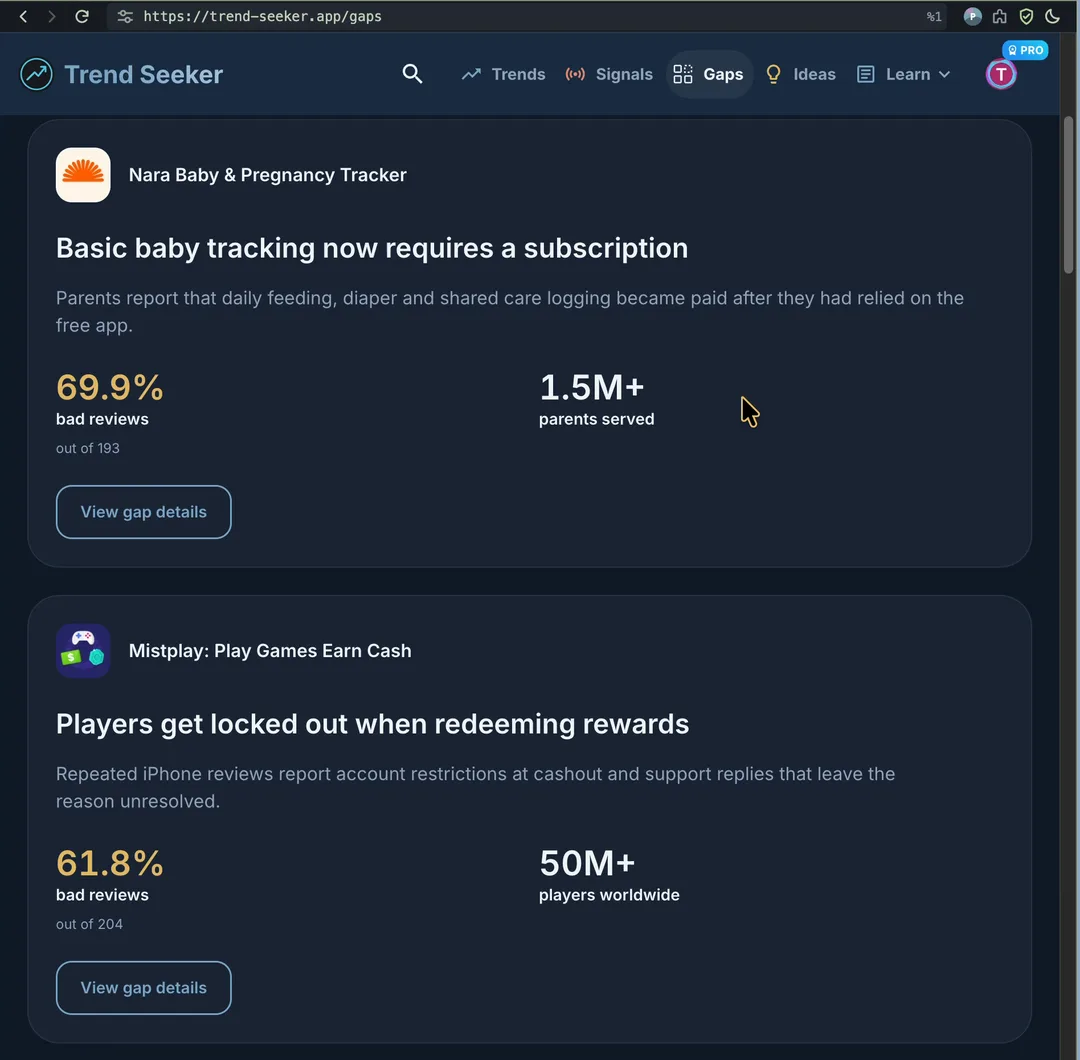
The first gap that week was Nara Baby & Pregnancy Tracker. The hero image above shows the card: 69.9% bad reviews out of 193 collected, and 1.5M+ parents served. A problem that size in an app that popular is worth opening.
The reviews explain it. Basic tracking for feeding, diapers and sleep moved behind a subscription, and many of the complaints are from the last few weeks.
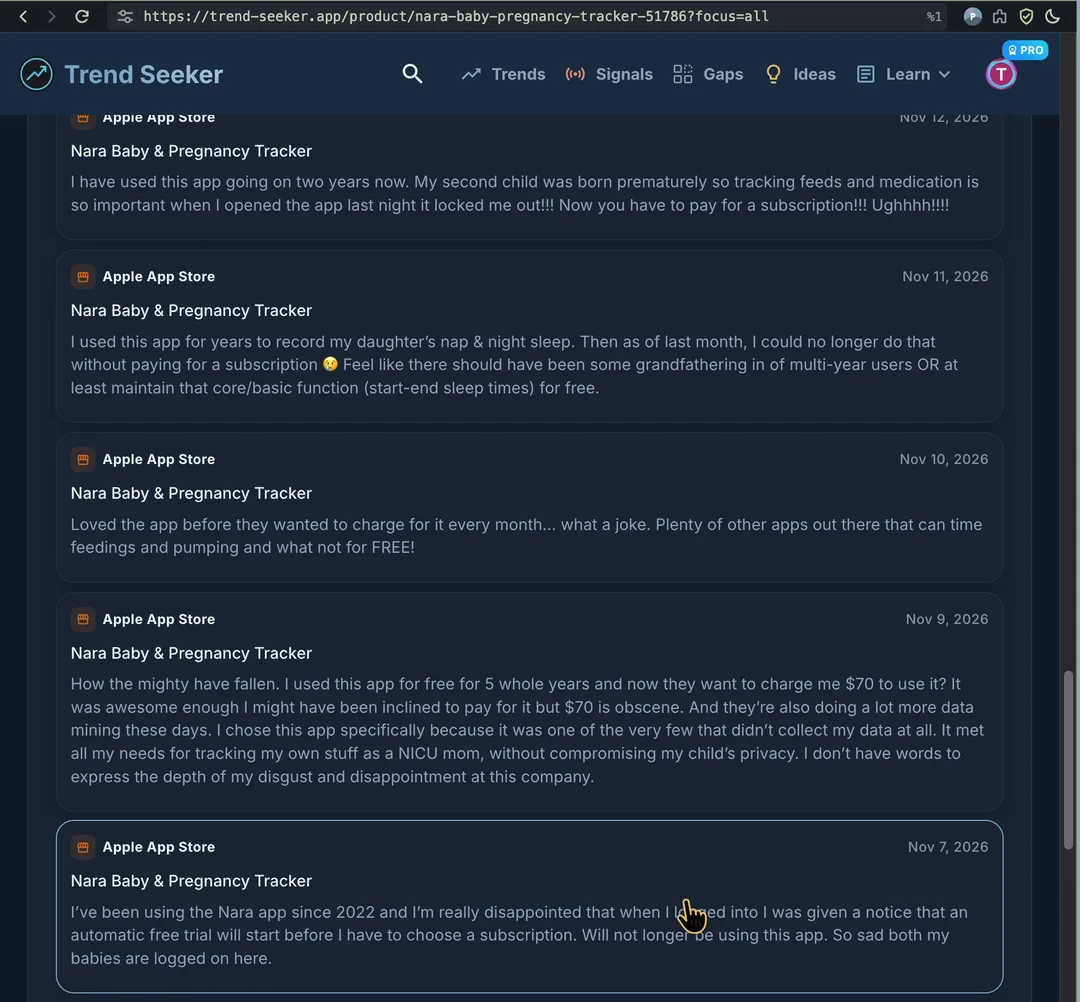
One parent wrote that they had used the app for free for five years and were now asked for $70. Another had tracked a premature baby's feeds and medication and found themselves locked out one night. These users want to leave and are looking for something else right now.
Since the complaint is about the price, the obvious opening is a free app that earns money some other way: ads, partnerships with baby product companies, or a YouTube channel around the same topic if the app grows.
The second gap was Mistplay, a "play games, earn cash" app with 61.8% bad reviews out of 204 and 50M+ players. One player got $15 back after months of playing. Another wrote that cashing out takes four to five days.
Not every bad review is an opening
When I filter the signal explorer to app reviews only, plenty of complaints are about Apple Music or Spotify. The complaints are real, but one person building a music streaming service against them is out of their league.
So the next thing I check is how big the app and its category are. Millions of reviews usually means a lot of competition. A smaller app, or a new category like AI apps or UGC video apps, is easier to take on early.
Within one category the bad-review share varies a lot. These are the Health & Fitness numbers from the recording:
| App | Bad reviews |
|---|---|
| MyFitnessPal | 46.1% |
| Calm | 21.5% |
| AllTrails | 20.4% (of 406) |
| WeightWatchers | 3.0% |
| Pacer Pedometer | 1.1% (of 2,461) |
I would not build a Pacer competitor today. It has 10M+ Android installs and almost no complaints. If those complaints started showing up, that would be the time to offer an alternative.
Small apps with very unhappy users
The "Start with the signals" section lists apps with smaller audiences and a lot of negative reviews.
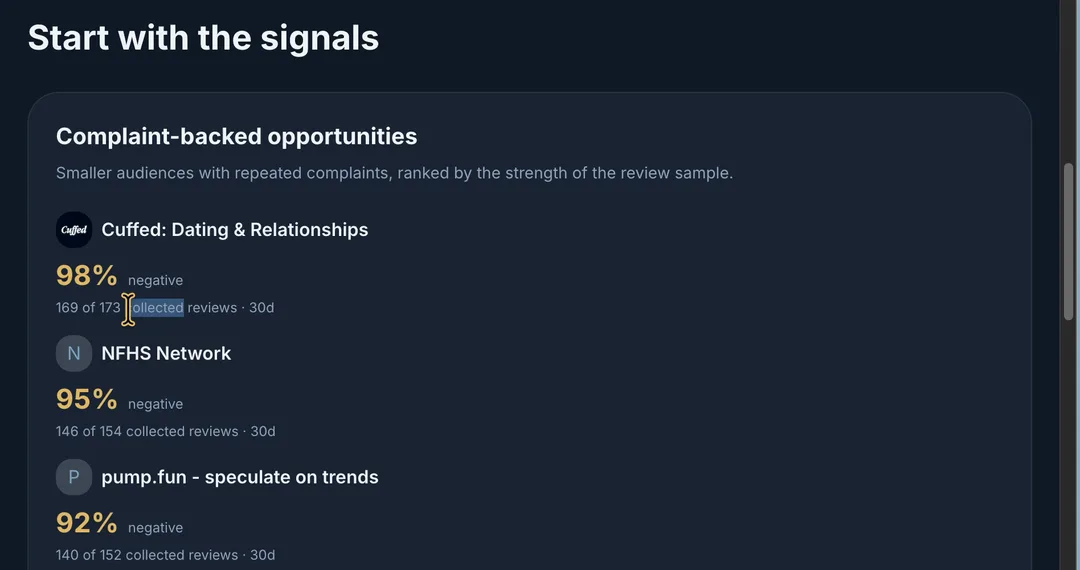
I think these suit indie developers best. Fewer users usually means a simpler product to build, and a small market means larger companies aren't competing for it. Procreate Pocket, a sketching app, is another example: 63.5% bad reviews and 12.9K store ratings.
Next to it is a list of recent launches with over a thousand votes on their platforms: Fundraisly with 1,615, Goldfish with 1,041 and Upstream with 1,011. A new market is still open. You can try the product, see what it does and launch your own take. Goldfish records what you work on and helps you write replies that sound like you. I am building something similar myself, so I would compete with it rather than pay for it.
Group similar apps into niches
One complaining app can be an accident. Several similar apps with the same problems is a category.
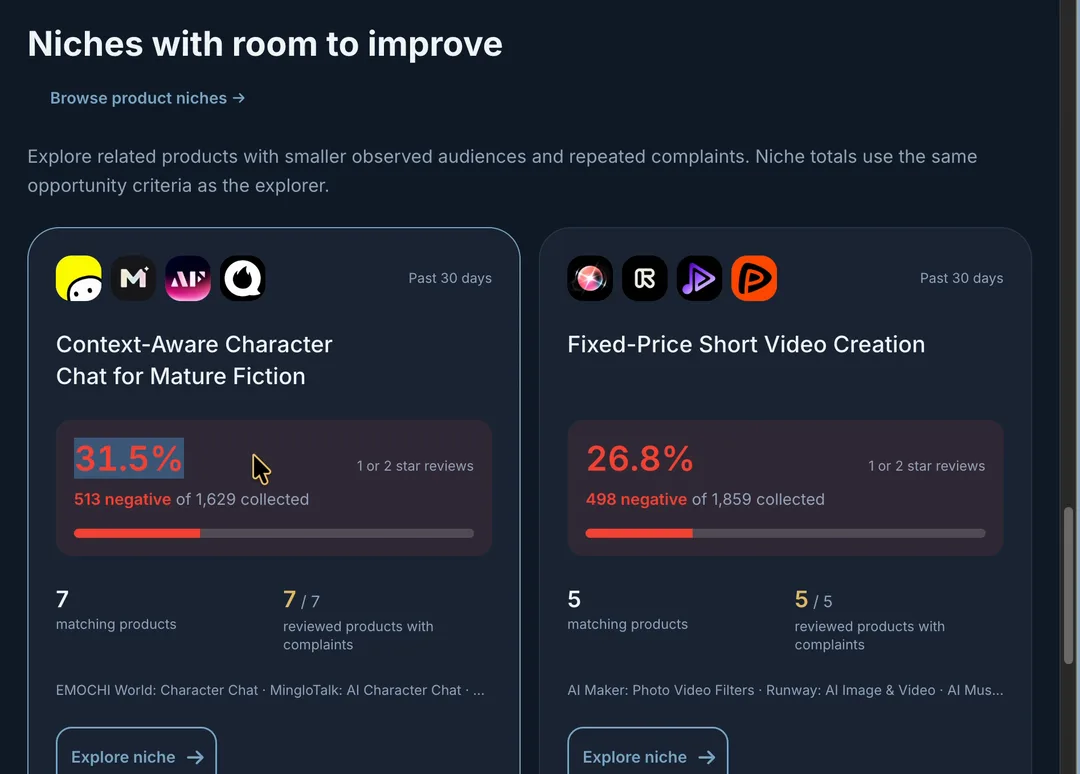
The character chat niche groups seven apps, including EMOCHI and MingloTalk. 513 of their 1,629 collected reviews are negative. It is a new category that grew with recent AI models, and a lot of its users are unhappy, so it is a good one to compete in. Short video creation apps are similar at 26.8%.
Revenue is the strongest proof
Reviews show that people use an app. Revenue shows that they pay for it. The market research section lists companies with known monthly recurring revenue from TrustMRR, IndiePage and Baremetrics.
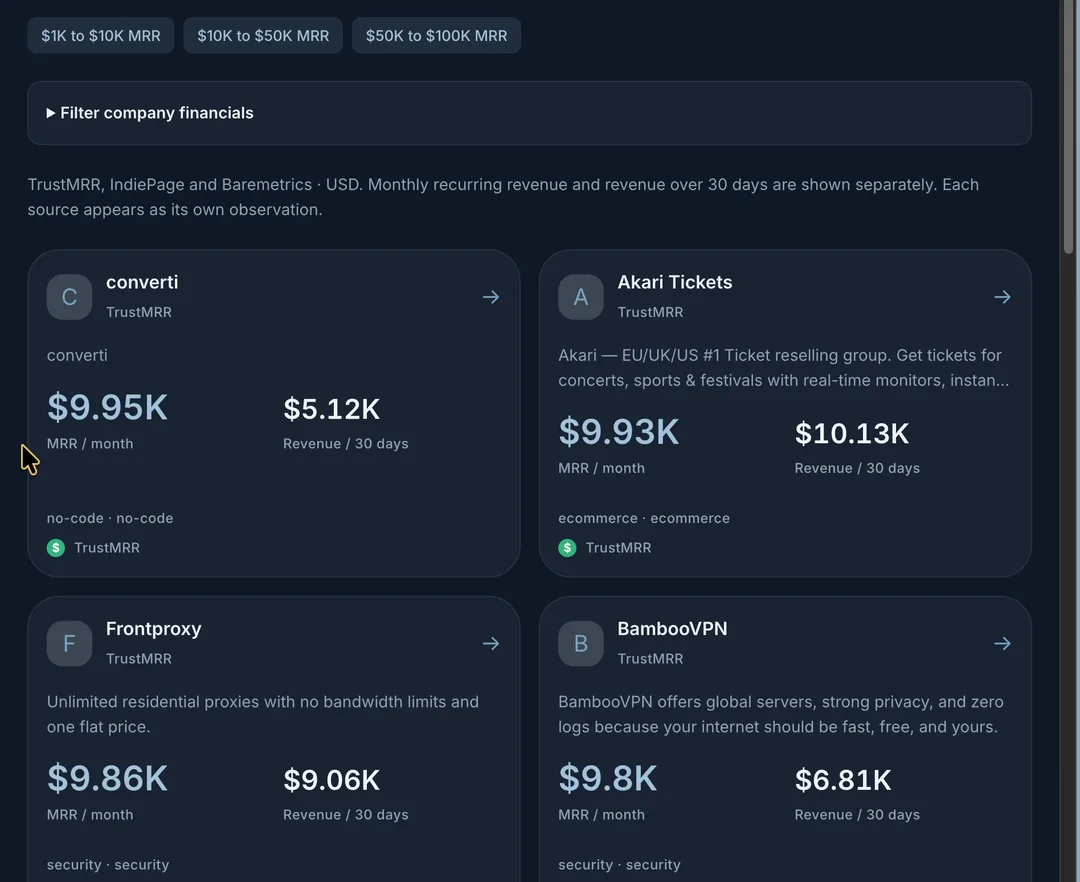
If a company makes $10K a month, the market is validated and people are already paying. I can look at its product and category and decide whether I can make something better. The filter goes by MRR size. A bigger market suits someone with more experience, and a smaller one is good for trying something out.
What I check before building
Back to the opening question: how do I avoid building for a problem nobody pays for? Before I write code, I check that:
- people already use an app for the problem,
- a meaningful share of its reviews are negative, and recent,
- the complaints point at something I can fix, like price, complexity or a broken flow,
- the app or category is small enough for one person to compete with,
- ideally, someone already earns revenue in the space.
None of this guarantees a product will work. The bad-review share comes from the reviews Gaps collected, not from every review an app has. It still tells me more than my own guess about what is useful.
You can browse the current gaps at trend-seeker.app/gaps. The full walkthrough is on YouTube, and the Nara example is also a one-minute short. If you have questions or want a feature added to Gaps, send them to [email protected].